

You have probably been there.
You find a posting that looks perfect at 9 p.m.
You rewrite your resume until midnight.
You submit.
Two weeks later: nothing. Or a rejection that clearly never read past the title.
The job was never worth that evening.
Not because you are not qualified. Because the fit was never there and the signals were visible before you applied.
Here is how I decide whether a posting deserves my time.
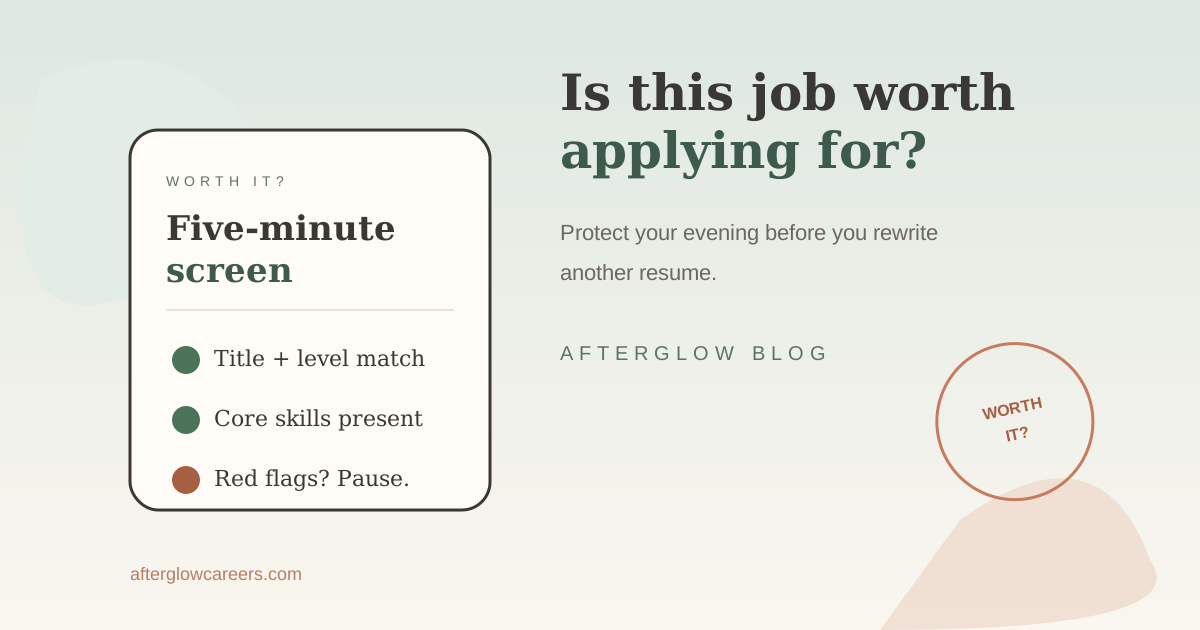
The five-minute screen
Before you customize anything, run this screen:
1. Title and level
Does the title match your target cluster? Does seniority language match your scope?
2. Must-have skills
Do you have most of the first five requirements, not buried nice-to-haves?
3. Location and work model
Is remote/hybrid/on-site realistic for you?
4. Posting age
Has the job been reposted for months with no movement?
5. Company signal
Do you know anyone there? Have you seen churn in that team?
If you fail two or more, pause. You can still apply. But go in with eyes open.
Green flags worth your time
- Clear outcomes in the first bullets (ship X, own Y, partner with Z)
- Reasonable requirement list (not a unicorn shopping list)
- Named tools you actually use
- Posting linked from the company careers site, not only an aggregator
- Recruiter or hiring manager reachable on LinkedIn
These do not guarantee an interview. They mean the company put thought into the role.
Yellow flags: proceed with caution
- Vague verbs everywhere ("support," "assist," "help with") with no ownership
- Title inflation ("Lead" with IC pay band language)
- Same job reposted every month
- Description copied from a different function
- "Fast-paced environment" with no detail about team or product
Yellow does not mean no. It means do not burn a custom resume until you learn more.
Red flags: protect your evening
- Requirements that combine three senior roles in one
- Unpaid trial projects or "exposure" language for experienced hires
- No salary range where your state or industry expects one
- Posting asks for passwords, IDs, or financial details up front
- Job reads like a backlog dump, not a role
Workforce analysts at SHRM and elsewhere have tracked persistent noise in online job listings, including stale and duplicate postings. Some openings never close because they were never real hiring priorities.
Source: SHRM: Workplace trends and forecasting
The qualification gap test
Separate missing one skill from missing the job.
If you lack one tool but the core work matches, you might still apply with a honest note about ramp time.
If the job needs deep expertise you cannot credibly claim in an interview, the application is theater.
The U.S. Department of Labor and related guidance have long distinguished between bona fide occupational qualifications and preference lists that inflate requirements. Many posting requirements are preferences dressed as gates.
Source: U.S. Department of Labor: Public law library (employment standards)
Read the first five requirements as the real gate. The rest is often wishful thinking.
Time budget: what is this application worth?
Not every job gets the same effort.
- Tier A (strong fit): custom resume, short note, maybe a referral
- Tier B (decent fit): light tailoring, standard resume
- Tier C (stretch or noisy): skip or one-click apply only if it takes five minutes
LinkedIn's own career guidance emphasizes standing out with relevance, not volume. Relevance starts with choosing better targets.
Source: LinkedIn: How to stand out when applying for jobs
If everything is Tier A, you will burn out. Most of your week should be Tier A and B, not C.
Questions to ask before you rewrite a resume
Say these out loud:
- Can I explain in two sentences why I fit?
- Would a former manager agree with my pitch?
- Does this role move my career where I want, or just pay rent?
- Do I know anyone who can tell me if this team is healthy?
If you stumble on the first two, sleep on it.
Where Worth It? fits
I built Worth It? inside Afterglow for the moment when a posting looks good but you are not sure.
Paste a job link. Afterglow scores fit against your resume, flags title mismatches, and surfaces risks before you spend an evening tailoring.
It is not a magic yes or no. It is a second opinion when your brain is tired and everything looks possible at 9 p.m.
The core career strategy stays free. Worth It? is Pro depth when you want more room to check postings before you commit time.
A simple worth-it checklist
“Strong title match + core skills + realistic level + credible company signal = worth a tailored application.”
Missing one of those? Maybe worth a lighter touch.
Missing three? Close the tab and pick a better target from your shortlist.
Frequently asked questions
Should I apply if I only hit 70% of the requirements?
Often yes, if the 70% is the real work and the missing 30% is learnable.
Women and other groups tend to apply at lower match rates than men for the same roles. Do not let a wish list scare you off a real fit.
What about ghost jobs?
Some postings stay open with no intent to hire soon.
Reposted roles, vague descriptions, and endless reposts are clues. Apply where you see motion: fresh posts, active recruiters, employee growth signals.
Is it worth applying with no referral?
Yes, when the fit is strong.
Referrals help, but a clear, relevant application still wins. Do not skip Tier A roles just because you lack an inside contact.
How does Afterglow help beyond Worth It?
Upload your resume once.
The free strategy shows target titles, Boolean searches, and companies to explore so your Tier A list is better before you open a single posting.
Protect your time like it matters
Because it does.
Every evening you spend on a job that was never a fit is an evening you did not spend on one that was.
Run the five-minute screen. Sort into tiers. Use Worth It? when you are unsure.
You deserve a search that respects your time, not one that punishes you for hoping.